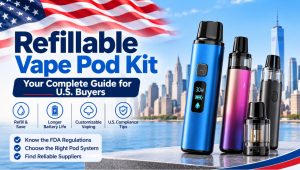
A refillable vape pod kit combines a rechargeable device with a pod that users fill from a separate e-liquid bottle. Unlike a prefilled closed-pod system, the pod is designed to be refilled; depending on the design, users replace either the coil or the complete pod when the heating element wears out. For adult consumers, the key questions are compatibility, maintenance, battery information and clear product labeling. For retailers, wholesalers, distributors and importers, the additional priority is verifying that each tobacco product has the required U.S. marketing authorization before it enters the supply chain.
Important: This guide is for adults of legal purchasing age and trade professionals. It is informational, not medical or legal advice. U.S. federal law prohibits tobacco product sales to anyone under 21. State and local rules may impose additional restrictions.
What Is a Refillable Vape Pod Kit?
A refillable vape pod kit usually includes a rechargeable battery device, one or more refillable pods, a coil or integrated heating element, a charging port and a user manual. The pod holds e-liquid and connects to the device electrically and mechanically.
“Refillable” describes the liquid container, not necessarily the heating element. Some pods have a replaceable coil; others have a built-in coil and are replaced as a complete pod when worn. Buyers should check the exact design rather than assume all refillable pods use interchangeable coils.
Refillable vs. Prefilled Pod Systems
| Feature | Refillable pod kit | Prefilled pod system |
|---|---|---|
| E-liquid | Added by the user from a bottle | Supplied in sealed cartridges |
| Consumable | Coil or refillable pod, depending on design | Prefilled pod |
| Setup | Requires filling and basic upkeep | Usually insert a sealed pod |
| Compatibility | Must match the device’s pod and coil family | Must match the device’s proprietary cartridge |
| Choice | Depends on compatible e-liquid and device specifications | Limited to compatible prefilled cartridges |
Neither format is universally right for every adult user. A refillable system requires more hands-on maintenance; a prefilled system reduces filling steps but limits cartridge choice. Do not assume that a pod is compatible simply because it looks similar or uses a magnetic connection.
Key Features to Compare Before Buying
1. Pod and coil design
Confirm whether the coil is replaceable or integrated into the pod. If it is replaceable, identify the exact coil series and available resistance options. If the coil is built in, check the exact replacement pod model and whether it remains available. A clear compatibility chart and model number are more useful than vague claims such as “universal pod.”
2. Filling method and leak-resistant construction
Pods may use top-fill, side-fill or bottom-fill ports. Look for a clearly identified fill opening, a secure sealing plug and a visible liquid level. Inspect the pod for cracks or damaged seals and follow the manufacturer’s fill line. Overfilling, worn seals, temperature changes and incorrect assembly can contribute to leakage.
3. Draw style and airflow
Many pod kits are designed for mouth-to-lung (MTL) use, while some support a looser restricted-direct-lung (RDL) draw. Airflow controls, coil resistance and power range work together; one specification should not be judged in isolation. Compare the manufacturer’s stated compatible coil range and operating instructions rather than relying on generic resistance rules.
4. Battery and charging details
Check the stated battery capacity, charging input, connector type and indicator behavior. USB-C describes the connector, not the charging speed or electrical rating. Use only the charging equipment and input specifications stated by the manufacturer. Do not use a device with a damaged battery, swollen casing, unusual heat or a damaged charging port.
5. In-box contents and replacement availability
Review what is included: device, pod, coil, cable, instructions and any spare parts. For ongoing ownership, confirm that compatible replacement pods or coils are identifiable and available. For trade buyers, request a current bill of materials or parts list, model-specific compatibility documentation and a clear warranty/returns process.
How to Fill and Maintain a Refillable Pod
- Read the device manual and identify the correct fill port and compatible e-liquid specifications.
- Remove the pod if the manual instructs you to do so. Open the fill seal carefully.
- Add liquid slowly without filling beyond the marked limit. Keep liquid out of the central airflow chimney.
- Close the fill port securely and wipe away any residue.
- For a new coil or pod, follow the manufacturer’s priming instructions and wait the specified saturation time before use. The required time varies by product.
- Check for leaks and ensure the pod is correctly seated before operating the device.
Replace a coil or pod when the manufacturer’s guidance indicates it is worn, or if there is persistent burnt taste, visible damage, repeated leaking or a marked change in performance. Do not continue using a damaged pod or coil. Keep e-liquid and devices away from children and pets; nicotine-containing liquid can be poisonous if swallowed or absorbed through skin.
U.S. Compliance Checks for Retailers, Wholesalers and Importers
Verify FDA marketing authorization at the product level
In the United States, a new tobacco product generally must receive a written FDA marketing order before it can be legally marketed. FDA explains that PMTA submission is an application pathway—not permission to sell while an application is pending. Check the exact product, manufacturer and relevant authorization details in FDA’s current searchable tobacco product resources. Do not treat a manufacturer’s statement, registration, laboratory report or pending application as a marketing order.
FDA also states that it does not “approve” tobacco products. Use accurate language such as “FDA marketing authorized” only when the exact product is covered by a valid order; do not use “FDA approved” as a general product claim.
Confirm age restrictions and sales controls
Federal law sets 21 as the minimum age for purchasing tobacco products, including e-cigarettes. Retailers should maintain age-verification procedures and review state and local requirements for in-person and online sales.
Review PACT Act and delivery obligations
ATF explains that businesses selling, transferring or shipping ENDS for profit in interstate commerce must register with ATF and with applicable destination states. The PACT Act framework also includes customer age verification, adult-signature delivery requirements, package labeling and other reporting or recordkeeping obligations. Businesses should confirm the requirements that apply to their transaction model and destinations before accepting orders.
Do not assume ordinary parcel shipping is permitted
The PACT Act restricts mailing vapes through USPS, subject to narrow statutory and postal exceptions. USPS Publication 52 describes specific exception procedures and documentation. Do not interpret an exception for a qualifying shipment as a general permission to mail consumer vape orders. Confirm eligibility and carrier rules before shipping.
Keep a traceable supplier file
Before onboarding a product, trade buyers should collect the manufacturer’s legal identity, exact model and SKU, product/authorization evidence, applicable warnings and labeling, technical specifications, battery and transport documentation, and a traceable invoice chain. Verify claims independently and retain records. State and local rules can differ, so a federal checklist alone is not sufficient.
Buyer Checklist: Consumer and Trade Purchases
- Confirm that the pod kit is genuinely refillable, not a sealed prefilled cartridge system.
- Identify whether the coil is replaceable or integrated into the pod.
- Check exact pod/coil model compatibility and replacement-part availability.
- Review fill-port design, liquid-level visibility and manufacturer maintenance instructions.
- Verify battery, charging input and safety instructions from the product manual.
- For U.S. commercial purchases, verify FDA marketing authorization for the exact tobacco product.
- Confirm age-verification, PACT Act, state registration and shipping requirements for the intended sales channel.
- Retain product specifications, invoices, labels and supplier traceability records.
Frequently Asked Questions
What is the difference between a refillable vape pod kit and a prefilled pod kit?
A refillable kit uses a pod that the user fills from a separate e-liquid bottle. A prefilled kit uses sealed cartridges that are replaced when empty. Both may have rechargeable batteries, but their consumables and maintenance steps differ.
Can I use any refillable pod with any vape device?
No. Pods and coils are usually model- or product-family specific. Check the device manufacturer’s compatibility information and use only the listed pod and coil models.
Do all refillable pod kits have replaceable coils?
No. Some use replaceable coils; others have a coil integrated into the pod, meaning the complete pod is replaced when the coil wears out. Check the product manual and replacement-part number.
How long should I wait after filling a new pod?
Follow the manufacturer’s priming and saturation instructions. The recommended waiting time varies with the coil and pod design; there is no single time that applies to every kit.
Is a refillable vape pod kit automatically legal to sell in the United States?
No. A refillable design does not create an exemption from tobacco-product rules. A new tobacco product generally needs a written FDA marketing order before it can be legally marketed, and retailers and distributors must also consider age restrictions, PACT Act obligations and state/local rules.
Can a U.S. retailer ship refillable vape pod kits through USPS?
Do not assume so. USPS generally restricts mailing ENDS, subject to narrow exceptions and specific eligibility and documentation requirements. Businesses should review the current PACT Act rules and USPS Publication 52 before arranging delivery.
Related U.S. Vape Buying and Compliance Guides
For a broader overview of rechargeable device formats, battery specifications and safety considerations, read our Rechargeable Vape Guide. Trade buyers can also review our U.S. Disposable Vape Regulations and B2B Buyer Checklist for additional FDA, import and distribution checks.
Official U.S. Resources
- FDA: Tobacco Products Marketing Orders
- FDA: Enforcement Actions Against Unauthorized Tobacco Products
- FDA: Searchable Tobacco Products Database — Additional Information
- ATF: Vapes and E-Cigarettes / PACT Act
- USPS Publication 52: ENDS Mailability Exceptions
Editorial note: Regulations and carrier policies can change. Verify current federal, state and local requirements and the exact product’s status before purchase, import, distribution or sale. This article is general information and is not legal, medical or safety certification advice.